Myok Compras

Procurement happens in many places. The case file, in only one.

Digitize and control public procurement in a traceable platform, reducing spreadsheets, emails and manual work from the initial request to the final minutes.

Myok Compras

The problem it solves

Many public procurement processes are still managed across spreadsheets, emails, manual documents and duplicate versions. This increases administrative workload, raises the risk of errors and makes it harder to maintain clear traceability throughout the process. When an internal review, audit or oversight request arrives, reconstructing what was decided, who was involved and which background information supported the decision can take too much time.

Myok Compras centralizes the process in a digital, structured and auditable flow, from the initial request through evaluation, document generation, minutes and closure.

Mercado Público publishes. Everything else lives in spreadsheets and emails.

Rework

The request arrives incomplete and goes back. Every round trip is days nobody records.

Lack of coordination

Nobody knows what stage a purchase is at or whose turn it is. You find out by asking.

Fragile case file

The record gets assembled when someone asks for it. Whatever was not written down is gone.

Repeated work

The same data is typed three times: in the request, in the document and in the portal.

Whoever approves, approves from their own account

Each person logs in and sees what is waiting for them, according to their role. The approval chain is defined once, at implementation, and everyone gets their own part by email and inside the system.

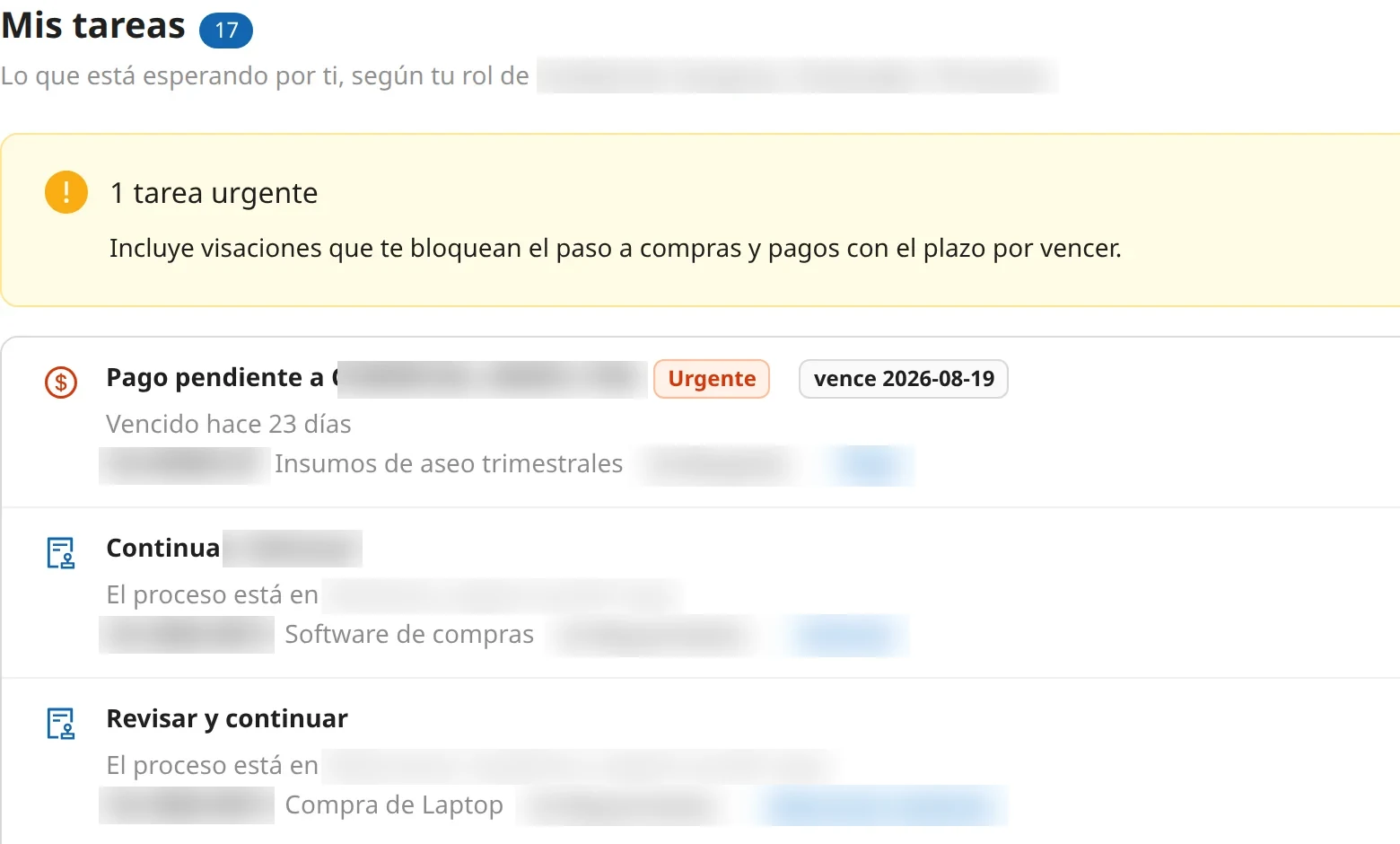
“My tasks” inbox: the list of what is waiting for the signed-in person, with urgency and due-date notices, and the process each task belongs to.
The task inbox of someone in procurement. Demo data, partially blurred.

Documents come out assembled, not rebuilt

With the information already captured, the system issues the documents the institution uploads to Mercado Público. Nobody copies the same data into a Word template again.

Your formats

Request record, technical specifications and whatever annexes the institution uses, with its letterhead and numbering.

With the right signature block

Each document carries the signature block of whoever corresponds, taken from the account that issues it.

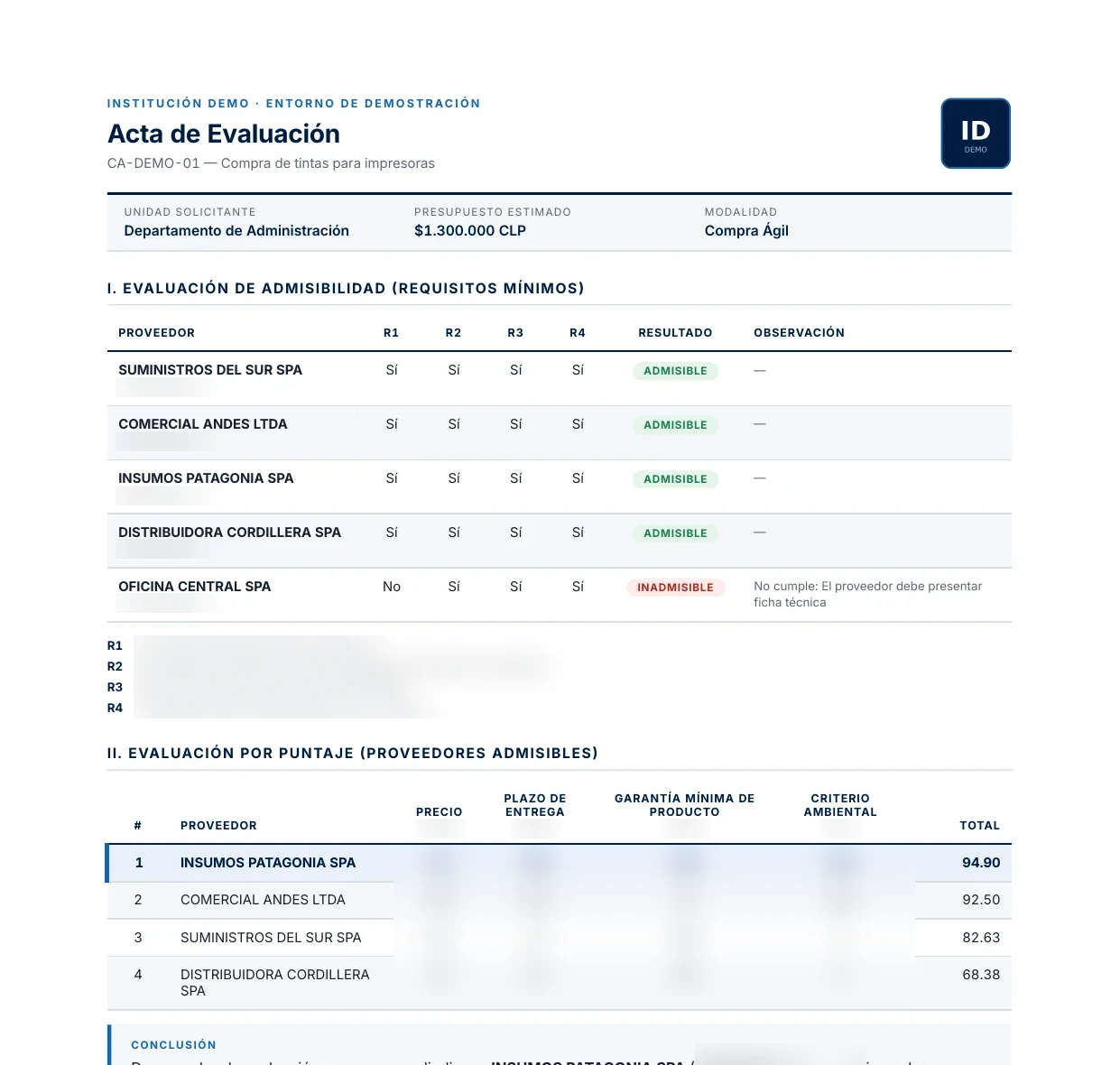
Evaluation record generated by the system: institution letterhead, eligibility table, scoring table with the ranking and the award conclusion.
Evaluation record generated by the system. Demo data, partially blurred.

Myok Compras

System features

Assisted supplier evaluation

Myok Compras organizes evaluation so admissibility, weighted scoring and ranking are consistent, verifiable and easy to review.

Minimum requirements with pass / fail status

Evaluable criteria, configurable by procurement type

Score calculation following whatever matrix the institution defines

Automated final ranking with criteria traceability
Fast, reliable information gathering

Standardizes the initial request intake so the requesting unit provides complete, comparable data that is ready to move forward.

Guided form for needs, products, quantities and technical specifications

Consistent fields for budget, currency, requesting unit and owners

Fewer later corrections due to incomplete background information

Initial information reused in documents and evaluation

Tracking and visualization: eyes on the process

Gives clear visibility into each procurement process so procurement teams, requesting units and managers know what is pending and who must act.

Process inbox with progress and owner in view

View of owners, documents, bids and associated evaluations

Progress tracking without relying on email threads

Operational continuity when an owner or team changes

Criteria library: flexible and configurable

Lets teams manage exclusionary and evaluable criteria so they can be reused, adjusted and kept consistent across processes.

Reusable criteria catalog by procurement type

Scales and rules configurable by the institution

Consistency validation before evaluation begins

Clear criteria for evaluators and internal control review

Dashboards and reports: supervise every process

Consolidates operational information to review workload, progress, results and closed processes from a management view.

Indicators for open, in-evaluation and closed processes

Reports by unit, status, period and procurement type

Fast reading of rankings, admissibility and results

Information prepared for internal follow-up and control meetings

Traceability and audit: organize and archive every movement

Records activity, documents, criteria and decisions to reconstruct the full process during internal review, audit or oversight.

Consultable activity history by user, date and stage

Documents and evidence associated with the procurement process

Record of applied criteria, admissibility, scores and ranking

Ordered archive for closure, operational continuity and accountability

How does your area benefit?

Procurement area

Gets an organized view of progress, owners, criteria, bids and documents, reducing manual follow-up and rework.

Requesting unit

Creates requests with complete, comparable data from the start, avoiding later corrections caused by missing background information.

Technical evaluators

Evaluates with clear criteria, admissibility matrices and consistent scoring, reducing the risk of calculation or evidence errors.

Approvers

Reviews minutes and consolidated background information from traceable data, making validation faster and more reliable.

Audit and internal control

Accesses history, activity, documents and recorded decisions to reconstruct the process without relying on emails or isolated files.

IT administration

Manages users, permissions, criteria and integrations in a centralized environment, improving operational control and system continuity.

Guided public procurement flow

The system organizes procurement into connected phases to reduce dependency on spreadsheets, email and external documents.

Twenty suppliers, a hundred documents, one single download

Once the purchase closes, bids and their background information enter the case file with no manual typing and no downloading files one by one.

The spreadsheet goes in as is

No renaming files, moving columns or formatting before loading it.

Background information arrives sorted

It is grouped by supplier and ready to review. What took a morning takes one click.

Under the institution's control

The Mercado Público connection is set up during implementation and operates within whatever scope the institution authorizes.

First who qualifies. Then who is best.

The system calculates and ranks. The buyer is the one who awards.

Stage 1 · Minimum requirements

Pass or fail, bidder by bidder. Whoever fails does not advance, and the reason is written down.

Stage 2 · Weightings

Price, lead time, guarantees: whatever the institution evaluates, with its scoring matrix. The system calculates and ranks.

Processes without weighting

Where the institution does not weight, the system proposes according to the rule configured for it, and any different decision is recorded.

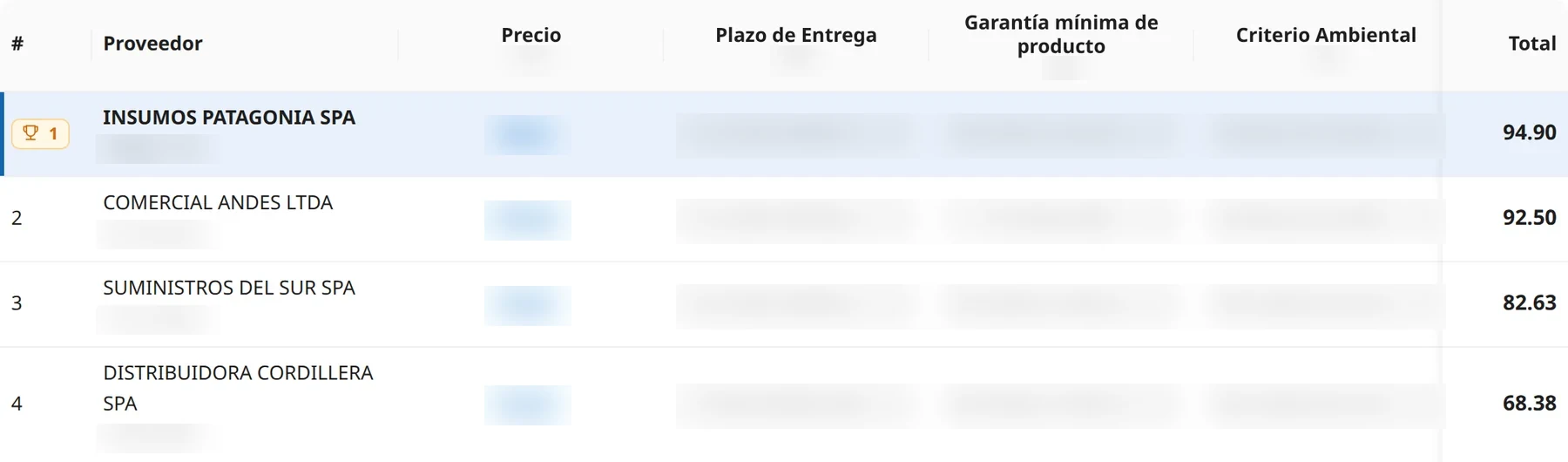
Weighting table: the admissible suppliers, the criteria they are evaluated on, each total and the top place highlighted.
Weighting table with the calculated ranking. Demo data, partially blurred.

The process ends when the goods arrived and were paid

Purchase order

Issued from the process, linked to the Mercado Público code.

Confirmed receipt

The warehouse records the delivery and attaches the receipt record.

Handover to payment

Conditional on receipt, and on whatever internal rules are configured.

Closure

What was requested, how it was evaluated, what was bought and what was received.

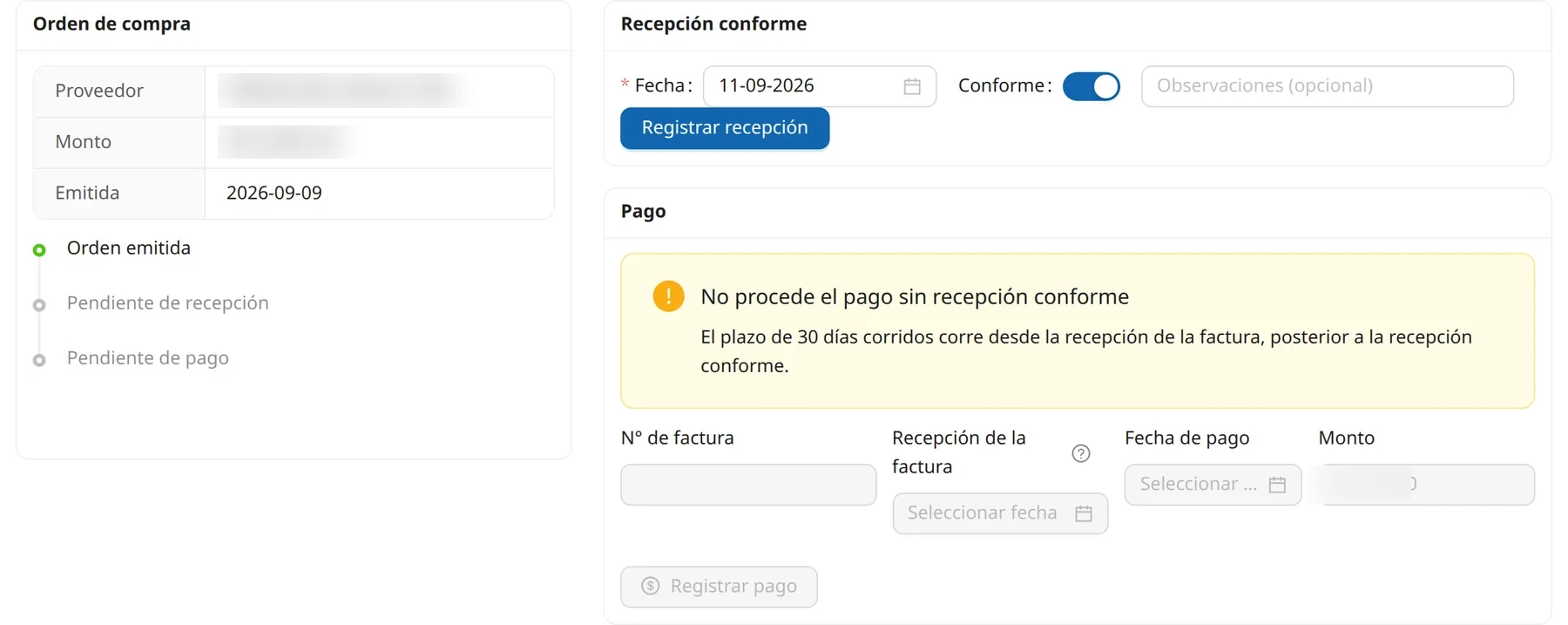
Receipt and payment screen: the issued purchase order, the confirmed-receipt record and the notice that payment cannot proceed without it.
Receipt and payment within the same process. Demo data, partially blurred.

Every control knows which rule it comes from

Law 19.886, Decree 661/2024 and ChileCompra directives. Each institution decides which ones halt the process and which only warn.

Some compute themselves

Whatever can be checked against the process's own data, the system resolves without intervention.

Others a person confirms

“Demand is not fragmented” requires human judgement, and that confirmation is recorded just the same.

All of them carry their citation

The regulatory library is kept current as part of the service, and the controls are reviewed when the rules change.

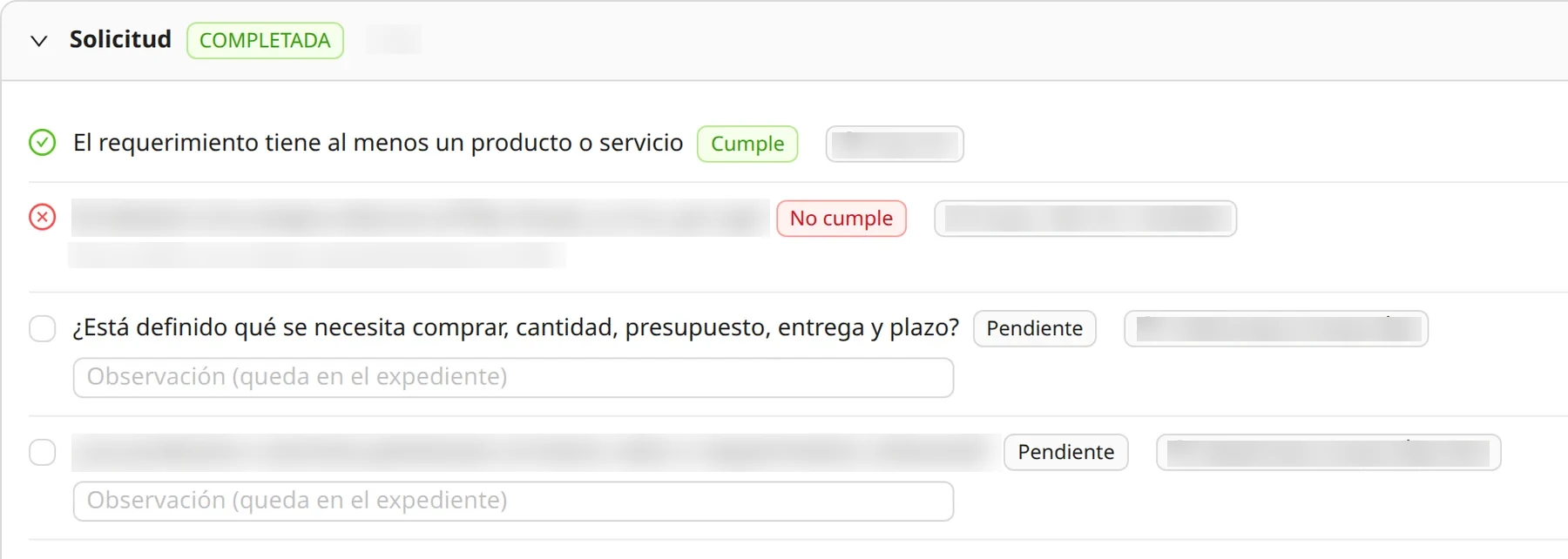
The controls of one stage: each with its result —pass, fail, pending—, its regulatory reference and the observation field that stays in the case file.
The controls of one stage, with their regulatory citation. Demo data, partially blurred.

It connects to the systems already in use

Advanced electronic signature

Process documents can be signed with FirmaGob or another accredited provider, when the institution requires it.

Document management systems

If the request originates in the institution's document manager, that connection can open the process here, with no double entry.

Open API

The system exposes an API on which any platform that also has one can integrate: finance, warehouse, or whatever comes next.

We support you through the whole implementation

This is not an account handed over and done: it is a configuration and support service. There is also a demo environment with accounts per role so the team can try it before deciding.

  1. 1

    Discovery

    How the institution buys today: real stages, approvers per purchase type and internal rules.

  2. 2

    Configuration

    Its route, its criteria catalogue and its documents are set up, with letterhead and signatures.

  3. 3

    Connection

    Link to Mercado Público and to the systems the institution already uses.

  4. 4

    Pilot run

    One pilot purchase walked end to end with the team, stage by stage.

  5. 5

    Operation

    Go-live and adjustments based on what shows up in real use.

Less Excel, fewer emails, more control: Myok Compras.

Let's talk and see how to adapt our solution to your institution's processes, roles and operational needs.

Request a demo / talk